Article: The Most Common Swimwear Mistakes & How to Fix Them
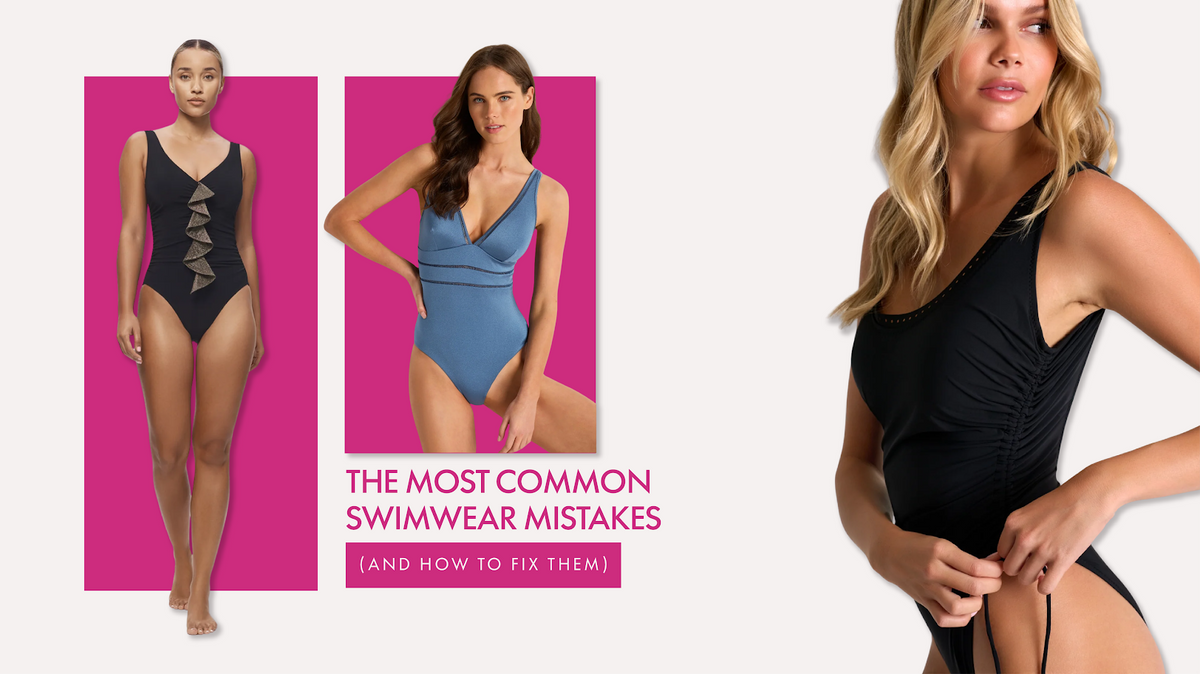
The Most Common Swimwear Mistakes & How to Fix Them
Have you ever worn a swimsuit and thought, This isn’t doing me any favors?
Before blaming the swimsuit or your body, take a closer look. Often, it’s not your body shape that is the issue; it's how the swimsuit is designed, its fit, the fabric used, or how it's styled.
Swimwear is different from regular clothing. There are fewer layers, less room for fabric to drape, and little chance for a poor fit to hide. An incorrectly placed waistband, a bulky detail in the middle, or a swimsuit that pulls in the wrong places can change how your body is perceived.
Thankfully, most of these missteps are easy to correct.
If you're looking for flattering swimwear, trying on a new one-piece, or wondering which styles make you look slimmer, here are some key things to consider.
Mistake 1. Breaking Your Silhouette in the Wrong Place
Think of your swimsuit as creating lines on your body. Where these lines start, end, and meet can affect how your shape is seen. A strong horizontal seam, a contrasting waistband, or a color-blocked panel placed across the widest part of your torso can make that area appear broader. This doesn’t mean horizontal lines or color blocking are bad. It just means their effect depends on where they are placed.
Think of a wrap-front swimsuit with its fabric crossing diagonally over the torso. Those angled lines naturally lead the eye across and around the body, creating a sense of movement. Color-blocking can work in much the same way, with darker or contrasting panels placed around the waist to visually define the middle.
The fix:
When choosing swimwear for women, don’t just focus on whether you like the design. Look at where the visual lines fall. Features like wrap fronts, diagonal seams, and thoughtful color-blocking can add definition to your silhouette.
Our picks:
 Anita Swimwear Dirban Care One Piece
 Gottex Day Dreamer V Neck One Piece Swimsuit
Mistake 2. Going for Maximum Coverage When You Actually Need More Shape
More fabric doesn’t always mean a more flattering swimsuit.
If you want to hide an area, cover it more, but too much fabric without any structure can sometimes make the silhouette look boxy.
A loose swim dress, an oversized tankini top, or long straight panels might cover the stomach and hips, but they can also remove any waist definition.
The trick is to have coverage that still shapes the body.
A swim dress with a shaped waist, a tankini with a fitted silhouette, or a one-piece with ruching can offer coverage without creating a solid block of fabric.
The fix:
Instead of simply looking for more coverage, think about where that coverage sits on your body. A higher neckline, fuller brief, or wider side panel can offer more coverage while still following your natural shape, rather than making the silhouette feel overly covered.
Our picks:
 Shan Billy-Rose One Piece
 Panache Anya Riva Balconnet Tankini Top
Mistake 3. Wearing a Waistband That Ends at Your Widest Point
Here’s a simple styling tip: pay attention to where your swimsuit bottom ends.
A waistband that sits directly across your widest part, such as your stomach or hips, can create a strong horizontal line at that area. If the elastic is narrow or tight, this effect becomes even more noticeable.
This is one reason high-waisted swimwear remains popular. A higher rise can elongate your torso and offer more coverage in the midsection, while a wider waistband can distribute pressure more comfortably.
Of course, high-waisted isn’t always the best option. The rise should match your proportions and shouldn’t roll, dig, or sit awkwardly.
The fix:
Experiment with different waistband heights. Try a mid-rise, high-rise, and classic bikini bottom in front of a mirror and see how each one divides your silhouette.
Sometimes moving the waistband just a few inches can make a big difference.
Our picks:
 PQ Florencia Smocked High Waist Bikini Bottom
 Robin Piccone Margot High Waist Bikini Bottom
Mistake 4. Choosing Shiny Fabric When You Want a More Sculpted Look
Fabric can completely change how a swimsuit looks in the sun. Highly reflective or glossy fabrics catch light, emphasizing curves, folds, and raised areas. Matte fabrics, on the other hand, create a smoother, more uniform surface. This doesn’t mean you have to avoid shiny materials. Metallic swimwear and glossy finishes can look amazing, especially when used as an accent.
The key is understanding the effect you want.
If you're looking for slimming swimwear, a matte or subtly textured fabric can offer a more streamlined look.
If you want to draw attention to your waist, neckline, or shoulders, a bit of shine in that area can help focus the eye there instead.
The fix:
Consider fabric finish as part of the design. A matte finish gives a more subtle look, while a shiny finish can make light an integral part of the overall style.
Our picks:
 Monte & Lou Core Collection Lustre Multi Fit V-Neck One Piece
 Robin Piccone Jane V Plunge One Piece
Mistake 5. Ignoring the Power of Ruching
Flat fabric creates a smooth surface, while ruching adds texture and breaks up the look.
This is exactly why ruched swimwear can be so effective when you're aiming for a softer, more forgiving shape. Gathered fabric adds texture and movement, rather than creating a single, straight line across the body.
Ruching is especially popular on the midsection of one-piece swimsuits, where it can help soften the appearance of the stomach without relying on tight compression.
However, there is a catch: placement is important.
Heavy gathering across the widest part of the hips can add visual volume, while side ruching or controlled gathering around the waist can create more definition.
The fix:
Look for strategic ruching, rather than simply choosing the swimsuit with the most gathered fabric.
Our picks:
 Karla Colletto Helena Ruched Underwire One Piece
 Seafolly Collective Twist Halter One Piece
Mistake 6. Wearing a Swimsuit That Doesn't Move With You
This is where a beautiful swimsuit can quickly become frustrating.
Stand still, and almost anything can look good. Sit down, walk, bend, raise your arms, or step into the water, and suddenly the swimsuit reveals what you really need to know.
A bottom that rides up, a neckline that shifts, or straps that constantly need adjusting can change the fabric's position throughout the day. This can create bunching, pulling, and awkward lines that make the swimsuit less flattering.
Swimwear should feel snug and secure, but not painfully tight. Experts suggest moving around while trying on a swimsuit to check whether it digs, gaps, rides up, or shifts.
The fix:
Do the swimsuit movement test before buying:
* Raise your arms.
* Sit down.
* Walk around.
* Bend forward.
* Twist from side to side.
* Check whether the fabric stays where it should.
If you find yourself constantly adjusting your swimsuit in the fitting room, you're likely to do the same thing when you're at the beach.
Mistake 7. Treating Tummy Control Like Compression
The term "tummy control" swimsuit might suggest that tighter is always better. But that's not the case.
Shaping swimwear typically works through construction, such as firmer fabric, lining, or control panels, rather than simply squeezing the body tightly. A well-designed control swimsuit can smooth the midsection while still allowing for comfortable movement.
Going down a size in search of "more control" can actually have the opposite effect. If fabric is stretched beyond its intended fit, it may dig into the body and create visible lines.
The fix:
Look for structured shaping rather than maximum compression. A supportive lining, wide waistband, or strategically placed control panel can often provide better results than choosing a smaller size.
Our picks:
 Miraclesuit Rock Solid Cherie One Piece Swimsuit
 Miraclesuit Azura One Piece
Mistake 8. Letting One Feature Do All the Talking
A large bow, dramatic cut-outs, oversized hardware, a huge tropical print, or statement ruffles can be fun and eye-catching. But when multiple attention-grabbing elements are present in the same area, they can visually add volume simply because the eye is drawn there.
This is where balance becomes your best friend.
If your swimsuit has an eye-catching neckline, you might keep the rest of the design subdued.
If the bottoms have bold hardware or a striking print, a simpler top can prevent the look from feeling too heavy.
The fix:
Choose one focal point.
Want to highlight your neckline? Go for an interesting one.
Want to define your waist? Try a wrap detail, belt, or contrast panel.
Want to show off your legs? Choose a clean, higher-cut leg.
The most flattering designs are often not the ones with the most going on, but the ones where every detail has a purpose.
Our picks:
 Empreinte Swim Podium One Piece
 L`Agence Hadley Twist Plunge One Piece
Mistake 9. Assuming Black Is the Only “Slimming” Colour
Black swimwear is stylish, versatile, and can create a sleek look.
But it's not magic, and it's not your only option.
Deep navy, chocolate brown, rich burgundy, forest green, and other rich shades can create a similarly sophisticated effect while adding more personality to your swimwear collection.
Even better, colour can be used to direct attention.
A darker bottom with a brighter top can draw the eye upward. A darker panel through the waist can create definition. Colour blocking can visually separate or connect different parts of the silhouette.
The fix:
Move beyond the question, Which colour is most slimming? Instead ask:
Where do I want the eye to go?
Our picks:
 Shan Classique One Piece
 Karla Colletto Sadie Lingerie Underwire One Piece
Mistake 10. Buying for the Body You Think You “Should” Have
Here's the mistake we'd most like to retire.
You don't need to find a swimsuit that makes you look like someone else.
The idea that certain bodies should only wear certain swimsuits is outdated. The most flattering swimwear is the one that fits your proportions, provides you the support and coverage you want, and makes you feel comfortable enough to enjoy wearing it.
Want a bikini?
Wear one.
Prefer a one-piece?
Great.
Love a bold print?
Go for it.
Want tummy control swimwear because you like the extra support?
Absolutely.
Understanding proportion is not about creating a list of what you're "allowed" to wear. It's about understanding why a particular swimsuit makes you feel fantastic while another leaves you reaching for a cover-up.
So, What Actually Makes a Swimsuit Flattering?
Forget the idea that there is one magical swimsuit that works for everyone.
Instead, look for five things:
-
A good fit – The swimsuit should stay close to the body without digging or gaping.
-
Balanced proportions – Details should work with your natural shape rather than visually dividing it into awkward sections.
-
Intentional placement – Waistbands, prints, ruching, seams, and colour blocking all influence where the eye travels.
-
The right structure – Supportive fabric, lining, cups, and waistbands can make a major difference to how a swimsuit sits.
-
Your comfort – If you’re spending the entire day pulling, tugging, and adjusting your swimsuit, it isn’t the right one—no matter how good it looks on the hanger.
And remember, swimsuit sizing can vary by brand and style, so your usual clothing size isn't always the best guide.
Taking your bust, waist, and hip measurements and comparing them with the size chart of the brand you're considering is a more reliable way to start.
The Takeaway
A swimsuit doesn't make your body look bigger. It's often the wrong proportions, poor fit, or misplaced design elements that create that effect.
Once you understand how swimwear creates visual lines, places details, and works with your body shape, shopping becomes less about hiding and more about choosing the right style for you.
So the next time a swimsuit doesn't look quite right, don't immediately put it back and blame your body. Experiment and look for thoughtful details that complement your shape. A new neckline, a strategically placed focal point, or even a different size can completely change the way a swimsuit sits and feels. The goal isn’t to change your body; it’s to find swimwear designed to work with it.